
Loading...
Serving Fontana, CA and surrounding areas. (909) 738-1647
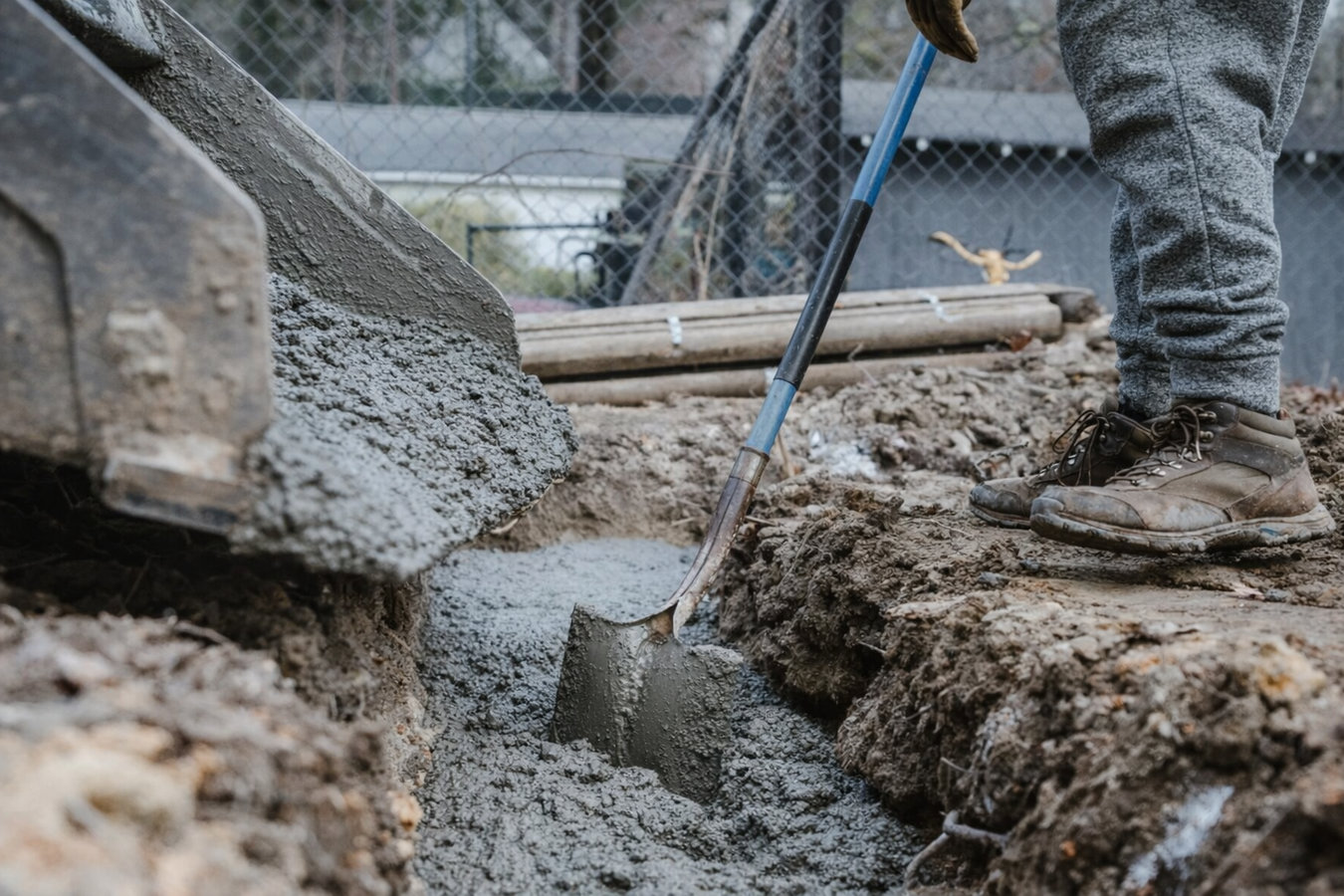
Building a deck, addition, retaining wall, or ADU? Your structure is only as solid as the footings underneath it. We design and pour footings for Fontana's clay soils and seismic zone, with permits and city inspections handled start to finish.
Concrete footings in Fontana are the underground bases that hold up structures - decks, additions, retaining walls, fences, and ADUs - by transferring the weight of whatever is above them down into stable soil below the active ground layer, and most residential footing projects run one to three days of physical work with a total project timeline of one to three weeks including permits.
Think of footings as the feet of a building. If the feet are not solid and in the right place, everything above them shifts, cracks, or sinks over time. In Fontana, the challenge is twofold: the clay-heavy soil common throughout the city swells and shrinks with the seasons, and the area sits in an active seismic zone near the San Jacinto Fault. Both factors require footings that are designed for local conditions - not just the minimum required in a more stable, lower-risk area. If your project also involves a larger foundation - say a full addition or new ADU - you will likely need both footing work and foundation installation as part of the same scope.
The most important thing to understand about footing work is the timing of the city inspection. In California, the inspector must see the excavation and steel placement before any concrete is poured. Once the concrete goes in, there is no way to verify what is underneath without tearing it out. That inspection is your protection - it confirms the footing was actually built to code, not just designed to be.
Cracks that start at the corners of doorframes or windows and angle outward across the wall are often a sign that part of your home's support has shifted. In Fontana, this kind of movement is frequently linked to expansive clay soil swelling and shrinking through wet and dry seasons. It does not always mean a catastrophic problem, but the underlying support should be evaluated before the movement gets worse.
When a door that used to swing freely starts sticking at the top or bottom, or a window no longer sits square in its frame, the structure around it has likely moved. This is one of the most common early signs that a footing or foundation element has shifted - and in Fontana's clay-heavy soil areas, it can happen gradually over several years. Catching it early means a simpler, less expensive fix than waiting until the movement becomes severe.
Any new structure attached to your home - or any freestanding structure like a large shed, pergola, or accessory dwelling unit - will require new footings before construction can begin. This is a code requirement in California, and your building permit will specify the footing design. If a contractor offers to build your deck or addition without mentioning footings or permits, that is a serious red flag.
If you notice a gap opening up between your house wall and an adjacent concrete patio, driveway apron, or garage slab, it often means one surface has settled while the other has not. In Fontana, this is frequently caused by soil movement beneath one of the slabs - and if the gap is near a load-bearing wall, it is worth having a contractor check whether the footing below that wall has been affected.
We handle the full footing process - site layout and marking, excavation to the depth required for your project and soil type, steel reinforcing bar placement to California seismic code, forming where needed, pouring, and curing. Every footing we build includes the steel placement required for Fontana's seismic zone - not a generic design, but one specified for this region's earthquake risk. For projects on lots with known clay soil conditions, we assess whether the standard footing dimensions are adequate or whether a wider, deeper footing is needed to resist soil movement. When your project also calls for foundation raising on an existing structure, we coordinate both scopes so the finished work ties together properly.
We pull all required City of Fontana building permits, schedule the pre-pour city inspection, and make sure the inspector signs off on the excavation and steel before any concrete is placed. You do not manage the building department relationship - we do. When the project is finished, you have a closed permit record on file with the city that shows the work was inspected and approved. According to the National Association of Home Builders, unpermitted structural work is one of the most common issues that surfaces in home sales - a closed permit record eliminates that risk entirely.
For homeowners adding an attached or freestanding deck, patio cover, or pergola - includes the permit and inspection coordination required for all California decks.
For new rooms, garage conversions, or accessory dwelling units - designed to California seismic standards and sized for the specific load of your structure.
For fences taller than code limits or retaining walls holding back soil - footings sized for the lateral load the structure will carry over its lifetime.
Fontana sits on alluvial fan deposits from the San Gabriel and San Bernardino Mountains, and pockets of expansive clay soil are common throughout the city. Expansive soil swells when it absorbs water during winter rains and shrinks during the long dry summers - a cycle that can tilt or crack footings that were not designed to handle it. A contractor who is not familiar with Inland Empire soil conditions may give you a footing depth and width that works fine in San Diego or coastal Los Angeles but fails here. Fontana is also located near the San Jacinto Fault Zone, which means California's building code requires footings to be built with earthquake forces in mind - more steel, specific hardware, and deeper perimeter ties than lower-risk areas. We work with homeowners across Colton and San Bernardino regularly, where the same fault proximity and clay soil conditions require the same careful approach.
Fontana's summer heat adds another layer of complexity. When temperatures top 95 degrees, fresh concrete can lose moisture too quickly before it has fully cured - resulting in surface cracks and a footing that ends up weaker than it should be. We schedule pours for early morning, cover the concrete after placement, and mist it during the first days of curing when the weather calls for it. These are standard practices on every summer project, not add-ons you have to ask for.
We come to your property to see what is being built, where the footings need to go, and what the soil looks like. Most residential site visits take 30 to 60 minutes. You will receive a written estimate within one business day - not a ballpark figure over the phone. The estimate includes excavation depth, steel sizing, and the expected permit timeline.
After you approve the quote, we apply for the City of Fontana building permit. This is our responsibility, not yours. Permit review typically takes one to two weeks depending on current workload at the building department. We schedule the crew once the permit is in hand so your start date is firm - not tentative.
The crew marks out the footing locations, digs to the required depth, and installs reinforcing steel inside the excavation. This is the most critical step - and the most important time for the city inspector to visit. We schedule the pre-pour inspection before any concrete is ordered, so there is no risk of pouring before approval.
Once the inspection passes, concrete is poured and finished. In Fontana's warmer months we schedule early morning pours and protect the fresh concrete from rapid drying. Curing takes three to seven days before any structural load can be applied. We manage the final inspection and deliver your closed permit paperwork when the job is complete.
We handle the permit, the inspection, and the pour. Call us or submit the form and we will get back to you within one business day.
(909) 738-1647We have poured footings across Fontana and the Inland Empire since 2024 - all in clay-heavy soils near active fault zones. We know the difference between what California's seismic code requires on paper and what actually holds up when the ground moves. That knowledge is reflected in how we size and reinforce every footing, not just the ones on complex jobs.
We have never poured concrete before the city inspector signs off on the excavation and steel. That is not a boast - it is the minimum standard for this type of work in California. The City of Fontana Building and Safety Division inspection is the only way to confirm the work underground is correct. We treat it as non-negotiable.
Our California C-8 concrete contractor license is active and in good standing - you can verify it on the CSLB website in about 30 seconds. Licensing means we carry required insurance and have met California's training standards. It also means you have legal recourse if something goes wrong - which is not the case with an unlicensed crew.
Fontana regularly hits 95 degrees and above from late spring through early fall, and concrete poured carelessly in that heat can crack before it cures. We follow American Concrete Institute hot-weather guidelines on every summer project - early morning pours, concrete protection from direct sun, and misting during the first 48 hours. You do not have to ask for this; it is how we work.
The footing is the part of your project you will never see again - which is exactly why it matters most. We build it correctly the first time so you never have to think about it again.
If an existing foundation has settled or sunk, foundation raising addresses the underlying cause rather than patching visible symptoms.
Learn moreBuilding an addition or ADU? Foundation installation covers the full foundation scope for new structures added to your Fontana property.
Learn morePermit season fills up fast - call or submit the form now to get your project on the schedule before the backlog builds.